


Search the site:
15 Powerful Income-Producing Activities for Service Businesses
Last updated: October 16, 2026
Income-producing activities are tasks that help you book paid work, retain clients, or get paid for the work you deliver. For service business owners, that includes following up on proposals, asking for referrals, discussing new projects with existing clients, and delivering on client commitments.
But these activities don’t all produce income on the same timeline. Following up with someone who’s already requested a proposal is a different proposition from starting a podcast and hoping clients find it.
When your time is limited, start with the opportunities closest to paid work. Then make room for the relationships and marketing that will help bring in future business.
| WHAT YOU NEED | WHERE TO START | FIRST ACTION |
| Opportunities for paid work soon | Proposal follow-up, past clients, relevant additional work for current clients | Contact someone who already knows your work about a specific opportunity |
| More potential clients | Referrals, networking, collaborations | Tell a relevant contact who you can help and what you have availability for |
| Better conversion from inquiries | Packages, proposals, consult calls, client proof | Address a recurring question or obstacle in your sales process |
| Future demand | Content marketing, guest appearances, targeted events | Answer a buying question or reach an audience that includes potential clients |
| Retention and repeat work | Delivering on commitments, proactive client conversations | Review upcoming deadlines and discuss what clients may need next |
Now, here are 15 income-producing activities to consider:
Table of Contents
Building Your Professional Network
Sure, networking is extremely obvious as a way to meet clients, but it tends to be something most business owners avoid. I get it. It’s hard to want to leave your home office, put on real pants, and talk to people. But if you’re hiding out at home, it’s really hard for people to find you and hire you.
Keep in mind that networking doesn’t have to be about throwing around business cards at an event and can be done in many different ways. You can meet people for coffee, connect online — get creative about your approach. The key is that you invest time in expanding your professional network as each new contact means one more potential client or collaborator.
Fostering Collaborations
The days of carefully guarding everything you know and never talking to your competition are over. Community over competition is where it’s at, and when you embrace this spirit, you may be surprised at where your clients come from.
Get to know your “competitors” and build relationships with people you could potentially collaborate with. Over the years, collaborations have led to additional revenue and opportunities I would have never had access to otherwise.
Asking for Referrals
From day one in my business, referrals have been my number one lead source, and 21 years later, that’s still true. Referrals are essential to you as a service business owner as it helps you expand your network and book clients that are partially sold on what you can do for them.
To ensure you have a steady stream of referrals, don’t go out into the world and talk about how you’re booked for months and months. When you do that, you’re telling people you’re too busy, and they’re less likely to refer business to you. And don’t just wait for people to refer you; proactively ask your current and past clients for referrals and then expand that to your broader network.
Make the referral easy. Tell people what kind of client you’re looking for, which problem you help with, and what you have availability to take on. “Send anyone my way” gives them homework.
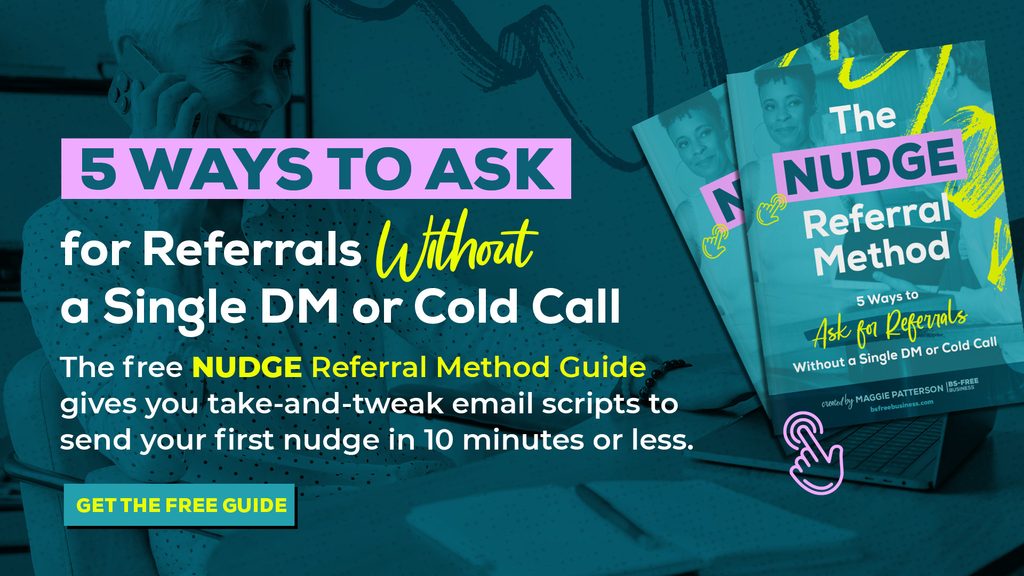
Need help asking for referrals?
Get the NUDGE Referral Method Guide now.
Staying in Touch with Your Network
How many times have you met someone only to realize the timing wasn’t quite right? As the saying goes, timing is everything, and that’s why you need to master the art of keeping in touch with your network.
So many times we forget about people that are potential clients or collaborators, and if we just nurtured those relationships, we’d have more opportunities than we can handle. Create some type of “keep in touch” system where you have a plan in place to stay in touch with people at set intervals.
Being a Special Guest Star
Remember all the stars over the years that made appearances on Friends? I sure do, and that’s because everyone loves a special guest star! To reach new audiences, look for ways to guest star on other people’s platforms (or as I call them — OPPs).
This can be done by guest posting, podcast or video interviews, guest teaching, speaking or any other way where you’re able to share with their existing audience.
Attending Events Where Your Clients and Referral Partners Gather
Want to make more money? Leave your damn house! I wish I was joking, but it’s really that simple. When you invest in attending events, you’re getting access to people you wouldn’t necessarily otherwise meet.
Look for industry events where your clients will be or events where you can meet potential collaborators and referral sources. And don’t overlook local or regional events; these smaller events have been some of my best sources of new revenue in the past two years!
Content Marketing with Purpose (Not Just Random Posting)
Content marketing can help potential clients find you, see how you think, and understand why they’d hire you. But publishing more isn’t a business strategy. You’ve got client work to do.
After years of running a content marketing agency, my advice is to start with the questions people ask before they hire you. What do they need to understand about the problem? What makes them hesitate? What would help them choose a service provider?
Use your blog, podcast, or newsletter to answer those questions with specific examples and recommendations that show your expertise. Then give readers a relevant next step, whether that’s exploring your services or requesting a consult.
The goal is to help people hire you, not give yourself a second job creating content. Focus on a format you can sustain, get that content in front of potential clients, and track whether it leads to inquiries and paid work. It takes time, so don’t count on a few posts to fill an immediate income gap.
Collecting and Using Client Testimonials and Case Studies
If you want to book more clients, you likely need more testimonials or even case studies that showcase the results your clients get from working with you. Many times, we skip over asking for testimonials when it’s actually one of the most powerful tools we have to help us find and close new clients.
A well-placed testimonial or case study on your website or in a proposal can be the thing that makes the difference between a potential client reaching out to you or not. And using this social proof strategically in your sales process can help make saying yes to working with you that much easier for your prospects.
Ask what was happening before you worked together, what changed, and what specifically helped. “Maggie is amazing” is lovely. Details about the work and its results give potential clients more to go on.
Creating Packaged Services
Let’s face it, selling your services can be challenging, especially when it comes to explaining what you do and what clients can expect. By investing time on packaging your services, you’re pre-defining what you offer, how you deliver those services, and even your pricing.
Taking the time to define or refine your service offerings makes it easy for your would-be clients to understand what you can do for them. Once your packages are set up, you can create sales pages for them, add them to proposals, and walk leads through them on your consult calls.
Producing Professional Proposals
If you write proposals, you know exactly how time-consuming they can be to create and how you can agonize over getting them just right. Your proposals are critical to being able to close a new client, but they don’t have to be super time consuming or stressful to create.
Start by creating a proposal template that positions you as the best answer to the client’s needs. With a template, you should be able to customize the scope of work and pricing to the client’s specific situation in a matter of a few minutes and come off looking like a professional every single time. Also, don’t forget to add more than just the scope of work and terms of the engagement. You want to include sections on why they should choose you and how you would work together as well.
Rethinking Consult Calls So They Convert
One of the biggest complaints I hear from service business owners is that they waste a lot of time on consult calls. And if this is you, it’s time for a re-frame where you approach consults as a way to connect with people and book potential business.
To make the most of your consult calls, you need to take the time to pre-screen people for fit before you get on the phone, and have a defined process to ensure calls aren’t a waste of time. The goal should be to book a potential client, and if not, to make a lasting connection that may turn into a client or referral source in the future.
Following Up on Inquiries and Proposals
You know those clients that never give you a solid answer or disappear after you send a proposal? Don’t write them off until you take time to follow-up with them and ensure you’re touching base with them in the future, as you never know when they may be ready to say yes.
This may seem like a waste of time, but rest assured, it’s not. A lead sometimes needs more time to decide or they’ll need your services down the road. Plus, you know this person is at least a little bit warm, which beats a cold lead every single time. You may be surprised how making an effort to consistently follow-up can pay off. I’ve personally had leads turn into clients for my agency or sign on as mentoring clients after months or even years have passed.
Follow up with a reason: answer an outstanding question, confirm their timeline, or ask whether the project is still a priority. Agree on the next contact where possible instead of sending “just checking in” emails indefinitely.
Finding Relevant Next Projects for Existing Clients
Running a service business means you’re in the business of serving your clients. And nothing can serve your clients more than you being proactive and identifying opportunities for their business. This may be something they’re doing that you know you can help with or a new opportunity for them.
Carefully examine what all of your clients are currently doing, and seek out ways you can help them do business even better. Then, take action to make these suggestions to your clients in a helpful way. I find that even if a client isn’t ready to expand our work together, they appreciate the diligence and thought you put into their business.
Contacting Past Clients
Your past clients are an amazing source of future business, and it’s so much easier to engage someone who already knows what you can do for them. Don’t let your past client contacts go stale! Reach out to them to see how they’re doing and suggest ways you may be able to work together.
For years, many of my clients have come back for new projects, and that’s been the result of keeping in touch and ensuring that they know we’d love to work together again. There have been clients that I’ve kept in touch with for years and that has meant we’ve been top of mind when a content marketing project came up.
Delivering on Client Commitments
Doing the work you’ve already been hired to do is an income-producing activity, even if it doesn’t have the excitement of landing a new client. Meeting deadlines, communicating proactively, and delivering what you promised all give clients reasons to keep working with you and recommend you to others.
Before you spend another hour trying to find new clients, make sure your current clients are getting what they paid for and you’re investing in the relationship. Your marketing makes a promise. Your client work needs to keep it.
What’s Next?
You don’t need to turn all 15 of these into a weekly checklist. You’ve got enough to do.
Start with what’s already in motion: outstanding proposals, past clients, current client needs, and people who’ve expressed interest. Then choose a manageable way to build future demand.
Pick the activity that addresses what your business needs now. Track whether it leads to paid work, repeat business, or useful conversations, not just another completed task.

I’m Maggie Patterson (she/her), and services businesses are my business.
I have 20+ years of experience with client services, am a consultant for agency owners, creatives, and consultants, and vocal advocate for humane business practices rooted in empathy, respect, and trust.
Read or Listen to the Latest







For Solo Business Owners

Growing a solo service business is tough.
It’s even harder when you’re bombarded with BS advice that steers you away from your values and why you started your business in the first place.
This is the podcast for solo creatives and consultants who want to remain as a team of one and have zero interest in the hustle and grind of typical business teachings.
Subscribe now and never miss an episode.



For Micro Agency Owners

Most podcasts for agency owners obsess over revenue growth as the ultimate success metric.

But here’s the truth: not everyone wants to make millions. Your goal might be to build a sustainable business that lets you have a life and doesn’t run you into the ground.
Join me as I spill my shameless confessions and share everything I’ve learned about building a micro agency that skips the BS of tired and typical agency teachings.
Follow Now on All Major Podcast Platforms